Questions answered in this guide
- Should I buy a picosecond laser or a CO₂ laser first?
- Can a CO₂ laser replace a pico laser for tattoo removal?
- Is fractional pico the same as fractional CO₂?
- Can fractional pico replace CO₂ for acne scars?
- Which is better for wrinkles, pores and skin rejuvenation?
- Which platform should I consider for melasma and darker skin?
- How much downtime should I plan for?
- How much does a picosecond laser cost compared with a CO₂ laser?
- Which laser can generate more revenue for my clinic?
- Do I need both lasers to open or expand a clinic?
- What training and service should I expect?
- How do I check Health Canada licensing before buying?
- What should I ask to see in a demonstration?
- Compare Pro 1 Pico and Alexa CO₂ for your clinic
Should I buy a picosecond laser or a CO₂ laser first?
Put a multi-mode picosecond platform first if your initial menu centres on tattoo removal, PMU correction, pigment treatments and fractional skin refinement. Put CO₂ first if your main investment goal is ablative resurfacing.
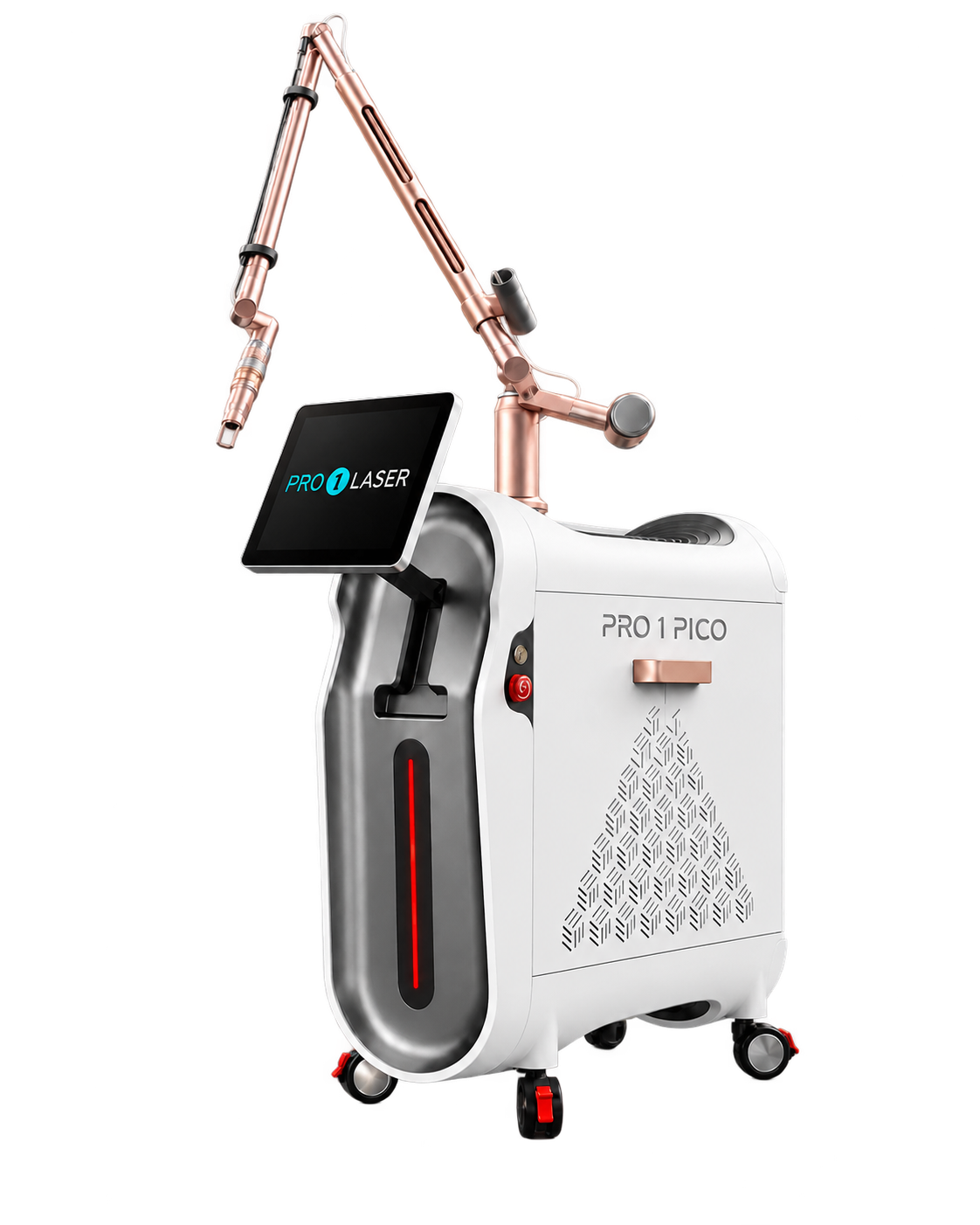
Pro 1 Pico brings picosecond delivery, PicoFusion™ quasi-nanosecond stacking and Long Pulse Nd:YAG together, with PicoMatrix™ fractional handpieces available for scar and skin-quality protocols. Alexa CO₂ Aesthetic supplies the fractional and ablative CO₂ capability for a resurfacing-focused practice.[6–8]
| What you want to add | Platform to evaluate first | Reason |
|---|---|---|
| Tattoo and permanent makeup removal | Pro 1 Pico | Pigment-targeting wavelengths and ultrashort pulse delivery |
| Pigmentation plus skin-refinement services | Pro 1 Pico | Direct pigment targeting and fractional treatment options |
| Acne-scar treatments with a less intensive recovery approach | Pro 1 Pico with PicoMatrix | Non-ablative fractional remodeling |
| Ablative resurfacing for etched lines and photoaging | Alexa CO₂ Aesthetic | Tissue ablation with a surrounding thermal effect |
| A broader corrective laser practice | Both, purchased in the order your demand supports | Complementary pigment and resurfacing capabilities |
If you already refer tattoo and pigment enquiries elsewhere, pico may fill the more immediate gap. If you already offer pigment services but refer resurfacing patients elsewhere, CO₂ may be your next step.
Can a CO₂ laser replace a pico laser for tattoo removal?
A CO₂ resurfacing laser does not replace a dedicated pigment-targeting laser for routine tattoo and PMU removal.
Picosecond tattoo treatment uses wavelength-specific energy to fragment ink particles for the body’s clearance processes. Clinical research has demonstrated tattoo lightening with 1064/532 nm picosecond systems.[5]
CO₂ primarily targets water in tissue. Its ablative action supports resurfacing and selected soft-tissue procedures. Those capabilities do not provide the same selective ink-fragmentation approach.
For a clinic planning tattoo or microblading-removal services, the purchase should be built around pigment-targeting technology. With Pro 1 Pico, the core 1064 and 532 nm wavelengths are complemented by optional 585 and 650 nm dye handpieces for selected blue and green pigments.[6]
Is fractional pico the same as fractional CO₂?
Both can deliver energy in a fractional pattern, but they create different tissue effects.
“Picosecond” describes pulse duration. “Fractional” describes energy delivery to a pattern of treatment zones, leaving tissue between those zones untreated.
Fractional pico optics concentrate ultrashort energy into microscopic focal points. At appropriate parameters, this produces laser-induced optical breakdown and microscopic cavities within tissue. Research has documented subsequent collagen and elastic-fibre remodeling.[1]
Fractional CO₂ creates microscopic columns of tissue ablation with surrounding thermal injury.
For the buyer, the distinction is important: PicoMatrix adds fractional remodeling to Pro 1 Pico; it does not turn the platform into an ablative CO₂ laser.
Can fractional pico replace CO₂ for acne scars?
Fractional pico can be a meaningful acne-scar treatment option. Whether it meets your clinic’s needs depends on the scars you intend to treat and the recovery profile you want to offer.
In a randomized split-face trial of 25 Asian patients with mild to moderate atrophic acne scars, both fractional 1064 nm pico and fractional CO₂ improved scarring. The investigators found no significant difference in clinical improvement. Mild post-inflammatory hyperpigmentation occurred on six CO₂-treated sides—24%—and was not reported on the pico-treated sides.[1]
A separate study first published in 2024 found better physician-rated improvement and patient assessments with CO₂, while pico produced fewer adverse effects. The difference in the ECCA scar-grading scores was not statistically significant.[2]
The practical implication is that fractional pico deserves consideration for scar services, while CO₂ remains valuable when ablative remodeling fits the treatment plan.
These trials evaluated other devices. They inform the technology comparison rather than establish identical outcomes for every platform.
For Pro 1 Pico, review the PicoMatrix fractional guide and arrange a demonstration centred on the scar and texture services you want to launch.
Which is better for wrinkles, pores and skin rejuvenation?
Choose according to the level and type of correction your patients want.
Fractional CO₂ has documented results in wrinkles and photoaging and is worth evaluating when tissue resurfacing is central to the treatment goal.[4]
Fractional pico offers a different pathway for skin-quality and remodeling services. Pro 1 Pico adds PicoFusion for stacked-pulse skin-revitalization protocols and PicoMatrix for fractional delivery.[6]
This creates a useful distinction in your menu: patients seeking pigment correction and ongoing skin refinement can enter through Pro 1 Pico services; patients seeking ablative resurfacing can be assessed for Alexa CO₂.
A clinic offering both can develop separate treatment pathways around those needs.
Which platform should I consider for melasma and darker skin?
If pigment concerns and a diverse patient population are central to your practice, look closely at a 1064 nm-based pico platform.
Wavelength, delivery mode and clinical protocol matter. At 1064 nm, epidermal melanin absorption is lower than at 532 nm. Pro 1 Pico provides 1064 nm delivery together with single and twin pulse options, giving operators several controls to consider during treatment planning.[6]
There is also clinical evidence for selected picosecond melasma protocols. A randomized trial involving 60 patients with Fitzpatrick III–IV skin found greater melasma improvement with the studied 1064 nm picosecond treatment than with the study’s 755 nm pico and 2% hydroquinone groups.[3]
Melasma should be assessed as a condition requiring a treatment and maintenance plan. Neither purchasing a laser nor choosing a shorter pulse establishes a permanent cure.
Ask the manufacturer to demonstrate how assessment, wavelength, pulse delivery and aftercare connect to the skin types your clinic treats. For CO₂, discuss the effect of treatment density and ablative injury on pigmentation risk.
How much downtime should I plan for?
Plan recovery around the procedure and its parameters. “Pico” is not a universal promise of no downtime, and “CO₂” is not one fixed recovery period.
A pigment treatment, fractional pico scar treatment and tattoo-removal session can produce different reactions. Tattoo removal can involve local swelling, blistering and scabbing.[9]
Fractional CO₂ involves healing of the ablative treatment zones. Depth, density, area and patient response affect recovery.
For a buyer, this changes the clinical workflow. Compare consultation requirements, treatment time, aftercare instructions, review appointments and the support your team will provide during healing.
If many of your patients cannot commit to ablative recovery, fractional pico is an important option to evaluate. If your patients actively seek resurfacing and accept its recovery requirements, CO₂ can address that demand.
How much does a picosecond laser cost compared with a CO₂ laser?
The published Laser Equipment Global listings provide these equipment-price starting points:[7,8]
| Platform | Published manufacturer-direct price | Published MSRP |
|---|---|---|
| Pro 1 Pico | CAD $89,950 | CAD $135,000 |
| Alexa CO₂ Aesthetic | CAD $49,950 | CAD $89,900 |
The written quotation establishes the configuration, taxes, delivery, training and payment terms for your purchase. These public prices should be compared alongside the included equipment package.
For Pro 1 Pico, establish whether the quote includes the 585 nm, 650 nm and PicoMatrix handpieces you want. For Alexa CO₂, establish which scanner, treatment handpieces and accessories are supplied.
Then compare the costs that continue after delivery:
| Cost to compare | What to establish in writing |
|---|---|
| Handpieces and accessories | Included items, optional upgrades and replacement prices |
| Consumables | Disposable supplies and any shot-based charges |
| Maintenance | Required servicing, calibration and component replacement |
| Training | Operators included, format, location and later staff onboarding |
| Repairs | Parts and labour coverage, transport charges and service arrangements |
| Financing or leasing | Deposit, payment schedule, total commitment and ownership-transfer terms |
This gives you a usable equipment budget and shows whether two quotations actually cover the same capabilities.
Request an Itemized Pro 1 Pico Quote · View Alexa CO₂ Aesthetic
Which laser can generate more revenue for my clinic?
Compare paid treatment demand, appointment capacity and contribution per visit. There is no universal revenue winner.
A multi-mode pico platform gives you several potential service lines: tattoo and PMU removal, pigment treatment, carbon peels and skin-refinement programmes. CO₂ can support a resurfacing service with a different consultation, treatment and follow-up workflow.
Start with three figures for each planned service:
- The price your clinic intends to charge.
- The number of paid appointments you can reasonably fill.
- The direct cost of delivering each appointment.
Monthly treatment contribution = completed paid appointments × (treatment fee − direct treatment costs).
Then deduct equipment payments and fixed clinic costs to assess affordability.
For example, 20 completed appointments at a hypothetical CAD $300 fee and CAD $75 direct cost would contribute CAD $4,500 before equipment payments and fixed overhead. This is an illustration of the calculation, not a revenue forecast.
For a multi-service platform, calculate each service separately and add the contributions. Include operator time and appointment availability so the plan fits your actual treatment room.
Model Pro 1 Pico Treatment Revenue · Model Alexa CO₂ Treatment Revenue
Do I need both lasers to open or expand a clinic?
You can start with the platform that supports your initial service menu and add the complementary system as demand develops.
For example, a clinic may launch tattoo and PMU removal with selected pigment and skin-refinement services using Pro 1 Pico. A resurfacing-focused practice may begin with Alexa CO₂.
Owning both becomes useful when you have suitable enquiries for both pigment targeting and ablative correction, trained operators and the capacity to deliver those services.
The first purchase should solve the gap you can identify in your business today.
What training and service should I expect?
Ask for training that follows the treatments you are buying the platform to perform.
For pico, that includes wavelength selection, single and twin pulse delivery, the role of PicoFusion and fractional handpiece selection. For CO₂, it includes energy, pulse control, density, scan patterns, clinical endpoints and recovery management.
Both need patient assessment, documentation, operating procedures and troubleshooting.
Pro 1 Laser supplies its platforms through a manufacturer-direct relationship with onboarding, clinical guidance and service support.[6–8] Agree on the operators attending training, its format and location, and how follow-up questions will be handled.
For service, establish who receives the request, how a fault is assessed, whether repair happens locally or requires shipping, and which costs the warranty covers. Put those answers in the purchase agreement.
How do I check Health Canada licensing before buying?
Ask for the Medical Device Licence number and check the equipment against Health Canada’s Medical Devices Active Licence Listing—MDALL.
MDALL lists licensed Class II, III and IV devices. Match the device name, licence holder and model identifiers to the quotation. A company’s Medical Device Establishment Licence, or MDEL, serves a different purpose from a device-specific MDL.[10,11]
Device licensing also addresses a different question from opening and operating your clinic. Check your city’s business-licensing requirements and your local public-health requirements for the services you plan to offer. Toronto, for example, publishes a specific licensing page for personal-service businesses.[12]
For more detail on the pico purchase, use the Canadian Pico Laser Buyer’s Guide.
What should I ask to see in a demonstration?
Bring your intended treatment menu and ask to see how the proposed configuration supports it.
For Pro 1 Pico, review the different delivery modes, wavelength handpieces and PicoMatrix patterns. Radial is circular, Lattice is square and Hexa is honeycomb. Compare their positioning and coverage on the treatment areas you expect to work with.[6]
For Alexa CO₂, review the fractional scanner, available scan shapes, energy and density controls, and the handpieces in your quote.[8]
Ask to see the operator manual and treatment documentation. Where clinical photographs are provided, review the indication, settings, number of treatments and follow-up interval alongside them.
You should leave the demonstration knowing what you are purchasing, which services you will start with and how your operators will be trained.
Compare Pro 1 Pico and Alexa CO₂ for your clinic
If you want to build around tattoo and PMU removal, pigment correction and fractional skin refinement, put Pro 1 Pico on your shortlist.
If your next service is ablative resurfacing, explore Alexa CO₂ Aesthetic.
Tell Pro 1 Laser which treatments you want to offer, what equipment you already own and which patients you serve. Our team can help you compare configurations, arrange a demonstration and prepare an itemized quotation.
Request Pro 1 Pico Pricing Explore Alexa CO₂ Aesthetic Speak with Dr. Ruby Dillon, Clinical Director: 604-649-1234
Sources
Clinical studies below evaluated their respective study devices and protocols; manufacturer pages document the Pro 1 Laser products and published prices.
- Sirithanabadeekul P, et al. Fractional 1064 nm pico versus fractional CO₂ for atrophic acne scars. Randomized split-face trial. Dermatologic Surgery. 2021;47:e58–e65. Study
- Yuan Y, et al. Fractionated 1064 nm pico versus fractional CO₂ for atrophic acne scars. International Journal of Dermatology. 2025;64:85–91; first published online 2024. Study
- Liang S, et al. Picosecond 1064 nm, picosecond 755 nm and 2% hydroquinone for melasma. Randomized controlled trial. Frontiers in Medicine. 2023. Study
- Fractional CO₂ resurfacing of wrinkles and photoaging: prospective profilometric study. Study
- Kauvar ANB, et al. Professional tattoo treatment with a dual-wavelength picosecond laser. Dermatologic Surgery. 2017. Study
- Pro 1 Laser: Pro 1 Pico technology and PicoMatrix fractional handpieces.
- Laser Equipment Global: Pro 1 Pico product and pricing.
- Laser Equipment Global: Alexa CO₂ Aesthetic product and pricing.
- FDA: Tattoo Removal: Options and Results.
- Health Canada: MDALL.
- Health Canada: About medical devices and licence types.
- City of Toronto: Personal-service business licensing.