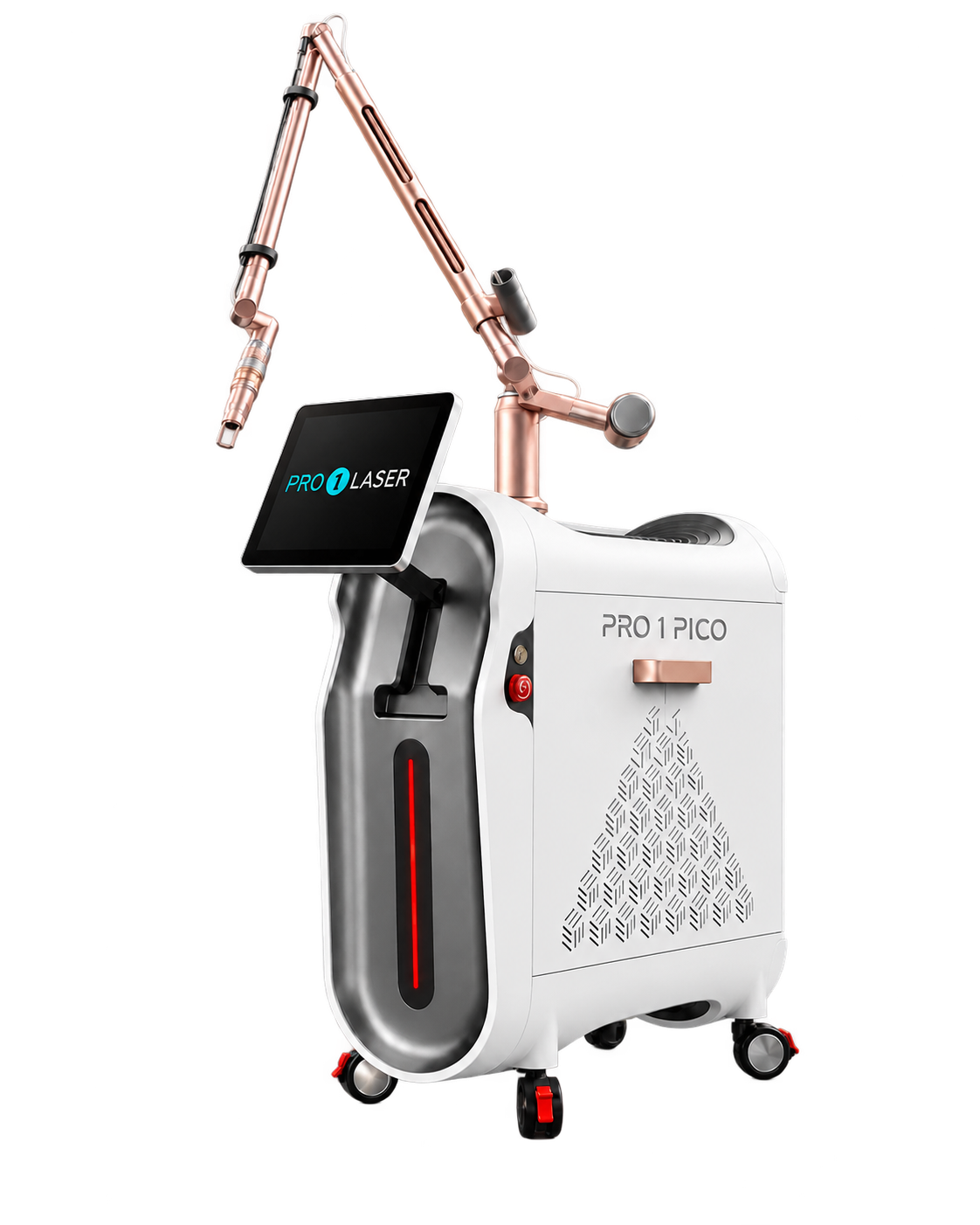
Smoother texture. Softer acne scars. More ways to rejuvenate skin. PicoMatrix™ expands Pro 1 Pico into fractional treatments that support collagen remodelling and help your clinic build a broader skin-quality menu.
Picosecond · PicoFusion™ · Long Pulse Nd:YAG Expanded with PicoMatrix™ fractional delivery.
Scar remodellingAddress depressed acne scars and uneven texture.
Skin refinementImprove the appearance of pores and fine lines.
More clinic opportunitiesAdd fractional skin-quality programmes to your menu.
What it adds
Give patients more reasons to choose your clinic.
Patients looking for clearer pigment often also want smoother skin. PicoMatrix gives you a fractional delivery option for the texture, scars and fine lines that affect how skin looks and feels.
01 / ACNE SCARS
Soften the appearance of depressed scars.
Fractional treatment supports remodelling within scarred tissue, helping improve skin contour and the appearance of atrophic acne scars. Clinical studies of fractional 1064 nm picosecond lasers have measured reductions in scar volume and improvements in texture.[1][3]
Visible pores and rough texture can remain even when pigment improves. Fractional picosecond research supports improvement in skin texture and the appearance of enlarged pores—giving your clinic a service focused on overall skin refinement.[1][2]
The fractional repair response supports collagen and elastin remodelling. Studies have documented improvements in wrinkles and skin firmness, while tissue biopsies have shown increases in collagen and elastic fibres after fractional picosecond treatment.[2][4]
Fractional picosecond delivery creates focal treatment zones without the surface-vaporising approach of ablative resurfacing. In a comparative acne-scar study, it produced less pain and shorter periods of swelling and crusting than fractional Er:YAG. Recovery still depends on the treatment intensity and patient.[3]
Concentrated treatment points. A skin-remodelling response.
PicoMatrix redistributes ultrashort picosecond energy into a patterned matrix of microscopic focal zones. These concentrated points initiate a controlled tissue response, with less-treated tissue between them supporting recovery.
This gives your clinician another way to direct the platform’s energy toward skin quality and scar remodelling.
1
Pattern the energy.
The fractional handpiece concentrates the beam into multiple microscopic treatment points.
2
Initiate a controlled repair response.
Highly concentrated picosecond energy produces localised tissue effects that stimulate remodelling.
3
Let improvement develop.
Collagen and elastin changes develop over time. Follow-up and a planned treatment series help assess progressive improvements in scars, texture and skin quality.[4]
Choose the delivery for the goal
How is PicoMatrix different from Full Beam?
The same platform offers two complementary ways to use picosecond energy. The difference is how that energy is distributed.
Treatment choice
Full Beam
PicoMatrix™ fractional
Delivery
Energy delivered across the selected beam spot.
Energy concentrated into a matrix of microscopic focal treatment zones.
Main purpose
Direct targeting of tattoo ink and unwanted pigment.
Fractional skin remodelling and refinement.
Menu focus
Tattoo and PMU removal; selected pigmentation treatments.
Depressed acne scars, uneven texture, visible pores and fine lines.
Clinic value
Build corrective ink and pigment services.
Expand into fractional rejuvenation and scar-treatment programmes.
The three PicoMatrix handpieces
Radial. Lattice. Hexa. Choose the pattern for your treatment area.
Each handpiece delivers a different fractional pattern. The practical choice is how you position that pattern, cover the treatment area and match the delivery to the patient’s skin and goals.
CIRCULAR PATTERN
PicoMatrix™ Radial
For precise placement across contours and smaller treatment areas.
The round fractional footprint supports controlled positioning on curved facial surfaces and defined zones where a circular pattern is convenient.
Use in your menu: localised texture refinement, visible-pore treatment and focal scar-remodelling protocols, according to the selected settings.
SQUARE PATTERN
PicoMatrix™ Lattice
For organised coverage of broader treatment areas.
The square fractional footprint helps the operator align adjacent placements across a treatment field, supporting a systematic approach to coverage.
Use in your menu: broader texture-refinement, rejuvenation and acne-scar treatment fields where organised placement is useful.
HONEYCOMB PATTERN
PicoMatrix™ Hexa
For fractional delivery in a honeycomb arrangement.
The interlocking pattern provides another configuration of focal treatment zones for fractional remodelling. Choose it according to the treatment protocol, coverage and tissue response.
Use in your menu: scar-remodelling and skin-texture protocols where honeycomb fractional delivery is selected.
Illustrations show pattern concepts, not actual beam dimensions, focal-point counts or treatment depth. These are overlapping fractional treatment applications, rather than a separate exclusive indication for each handpiece. Pattern, wavelength, energy and coverage are selected together during treatment planning.
The clinical evidence
Research behind fractional picosecond treatment.
Published studies support the use of fractional 1064 nm picosecond technology for scars and skin refinement. Here is what the research actually measured.
Acne-scar volume and visible pore counts improved.
A study of 59 patients with skin phototypes III–IV reported a 22.03% reduction in acne-scar volume and a 15.13% reduction in enlarged-pore counts after one fractional picosecond session. Pore diameter did not change significantly.[1]
Wrinkles, texture and firmness showed improvement.
In a prospective study of 22 participants, three fractional 1064 nm picosecond sessions produced measurable improvements in wrinkles, texture, skin depressions and pores. Skin firmness and elasticity also improved.[2]
Scar improvement with a lighter recovery burden.
A randomized split-face pilot study involving 31 Asian patients found comparable clinician-assessed scar improvement between fractional picosecond and fractional Er:YAG after four sessions. Picosecond treatment caused less pain, shorter swelling and crusting, and less post-inflammatory hyperpigmentation; patients rated scar improvement higher on the Er:YAG side.[3]
Biopsies documented tissue remodelling.
A randomized comparison of fractional picosecond and fractional CO₂ treatment in 25 Asian patients found improvements in acne-scar texture and volume. Biopsies showed increased collagen and elastic fibres at three months after both treatments.[4]
These studies evaluated other fractional picosecond systems, not Pro 1 Pico or its individual PicoMatrix patterns. They support the treatment approach; the reported percentages are study findings, not promised outcomes for your patients.
Why it matters for your clinic
Turn more patient goals into services you can offer.
PicoMatrix complements the platform’s pigment and ink capabilities with fractional skin-quality services. That gives you more ways to use one device throughout your clinic’s week.
Build a broader menu.
Offer scar-remodelling, texture-refinement and rejuvenation consultations alongside tattoo, PMU and pigment services.
Plan treatment series.
Fractional studies commonly use multiple sessions. A clinically appropriate series creates an ongoing patient journey with planned reviews and progress photographs.
Serve more of your existing patients.
A patient interested in pigment correction may also want to address acne scars or fine lines. Discuss those goals and build a staged plan when suitable.
Model your treatment mix.
Use your own volumes and prices to explore what fractional services could contribute to your clinic. Revenue depends on local demand, pricing and operating costs.
What is the main benefit of PicoMatrix fractional?
PicoMatrix adds fractional delivery for skin remodelling to Pro 1 Pico. It broadens your treatment options for depressed acne scars, uneven texture, visible pores and fine lines, alongside the platform’s full-beam tattoo and pigment capabilities.
Does PicoMatrix stimulate collagen?
Its concentrated focal treatment zones are designed to initiate a controlled repair response. Fractional picosecond studies have demonstrated collagen and elastic-fibre changes in tissue biopsies, supporting its role in skin remodelling.[4]
Does fractional picosecond treatment have downtime?
It can cause temporary redness, swelling, pinpoint bleeding or crusting, depending on the settings and patient. Comparative research has reported shorter recovery for some effects than ablative fractional resurfacing. Your clinician will explain the expected recovery for the proposed treatment; it is not a guaranteed zero-downtime procedure.[2][3]
Can it be used on darker skin?
Fractional 1064 nm picosecond treatment has been studied in skin phototypes III–IV and Asian patient groups. That provides useful clinical evidence, but suitability depends on skin type, pigment history, scar characteristics and settings. Evidence in those groups does not establish the same risk profile across every skin type.[1][3]
How many treatments are usually needed?
The cited studies used one to four sessions, with improvement assessed over subsequent weeks or months. There is no single course for every patient. Scar type, treatment intensity and goals determine the plan, and collagen remodelling continues after a session.[1][2][3]
Is PicoMatrix the same as PicoFusion™?
No. PicoMatrix is fractional beam delivery through a dedicated handpiece pattern. PicoFusion™ is the platform’s quasi-nanosecond stacked-picosecond mode. One describes the beam’s distribution; the other describes energy delivery over time. Your training covers how to select the appropriate mode and handpiece.
Does a clinic need to purchase a separate laser?
PicoMatrix is part of the Pro 1 Pico handpiece system. Discuss your intended treatment menu with Pro 1 Laser to choose the platform and handpiece configuration that fits your clinic.
See what PicoMatrix can add
Build the treatment menu your patients are asking for.
Explore Pro 1 Pico and PicoMatrix with a manufacturer-direct demonstration. We’ll discuss your treatment goals, handpiece configuration, training and pricing.