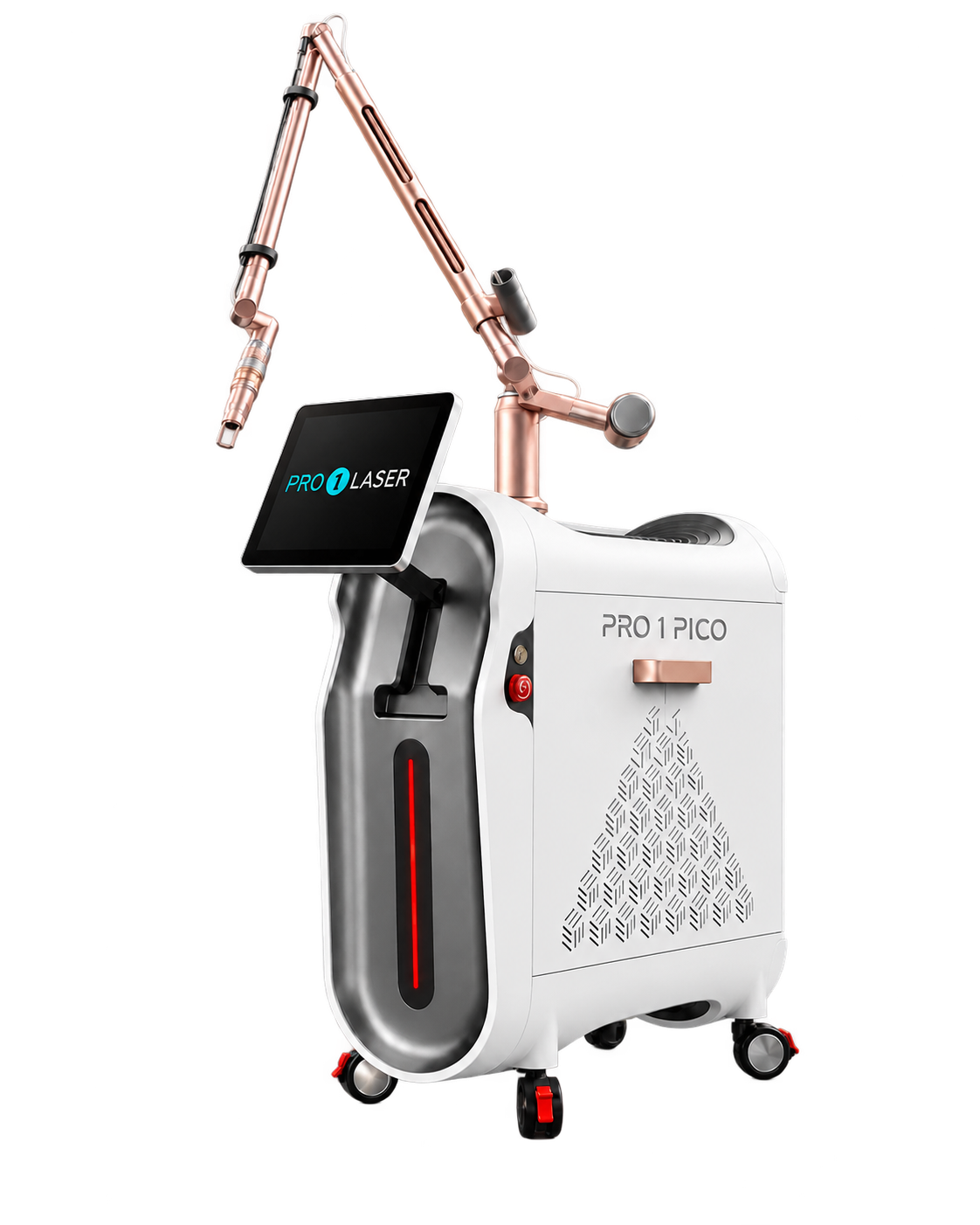
Buying a pico laser? Build a bigger treatment menu.
Choose a platform that opens more doors for your clinic. Compare true picosecond delivery, treatment modes, wavelengths and fractional handpieces—then look closely at the training and support behind your investment.
18 treatment opportunitiesExplore one platform's versatility
Direct training & supportWork with the manufacturer
By Pro 1 Laser · Updated · A manufacturer-written guide for professional equipment buyers
01 / Buy for the services you want to offer
What will your clinic be able to do with its next laser?
Your equipment purchase should begin with the patients you serve and the treatments you want to add. A clinic focused on tattoo removal needs a different configuration from one building a broader pigment, scar and skin-rejuvenation menu.
Write down the requests your team already receives, the services you currently refer elsewhere and the treatments that could complement your existing appointments. That shortlist gives every demonstration and quotation a purpose. It also helps you judge whether a platform can support your next stage of growth.
INK & PERMANENT MAKEUP
Turn removal enquiries into a service line.
Compare the wavelengths and handpieces available for the ink colours you expect to see. PMU removal also requires training in pigment assessment, colour changes and staged treatment planning.
Ask how the platform approaches pigmentation, melasma, carbon peels and rejuvenation. Each service needs its own assessment and protocol; a long treatment list should be backed by practical operator guidance.
Fractional delivery brings scars, pores and texture into the conversation. Long-pulse Nd:YAG adds a separate delivery mode for selected vascular, hair-reduction and other applications.
Three delivery modes and a specialized handpiece suite give your clinic several paths to expand from one console. Start with a focused menu, then develop additional services as your team's training, patient demand and appointment capacity grow.
02 / Understand the technology you are buying
Verify the pulse. Compare the whole platform.
“Pico” is a useful starting point for your search. The buying decision needs measurable specifications: pulse duration, wavelength, energy, spot size and the delivery modes that are actually available.
A picosecond is one trillionth of a second; a nanosecond is one billionth. A 500 ps pulse is 0.5 ns. Ask for the documented pulse duration at each relevant wavelength and the energy available at the spot sizes your operators will use. Spot size, fluence and beam consistency all matter to the treatment workflow.
A nanosecond Q-switched laser can have a legitimate clinical role. Compare it as that technology. When considering a picosecond platform, ask the supplier to explain the individual pulse duration, any pulse-stacking modes and the evidence supporting the services being proposed.
Pro 1 Pico's three complementary delivery modes
Delivery
What to understand
The buying question
True 500 ps picosecond
Ultrashort delivery at 1064 and 532 nm for tattoo ink and pigment applications. Single and Twin Pulse delivery options add flexibility.
What pulse duration and usable energy are documented for each wavelength and spot size?
PicoFusion™ Quasi-nanosecond
A sequence of stacked picosecond pulses provides a separate delivery approach within Pro 1 Pico's skin-rejuvenation offering.
How does the stack differ from a single picosecond pulse, and how is it used in the proposed protocols?
Long-pulse 1064 nm Nd:YAG
Longer energy delivery broadens the platform beyond ultrashort pigment work into selected thermal applications.
Which additional services fit my clinic, and what training supports those applications?
PicoFusion™ is the name of the stacked-pulse mode; it should not be read as a claim that the platform's individual pulse duration is 750 ps. PicoMatrix describes fractional beam delivery, a separate feature from pulse duration.
Compare usable wavelengths.
Pro 1 Pico provides native 1064 and 532 nm wavelengths, plus 585 and 650 nm dye handpieces for selected colour targets. Ask which wavelengths come from the core laser and which require a specialized handpiece.
For every additional wavelength, compare the available energy, spot size, maintenance and replacement costs. A wavelength label on its own does not describe the complete capability.
PicoMatrix™ offers round, square and honeycomb fractional patterns. These give operators different ways to position and cover a treatment area for scar-remodelling and skin-quality protocols.
Ask to see all three handpieces, review how they are selected and confirm the configuration in your quote. Their applications overlap; the pattern alone does not establish a separate exclusive indication.
Ask for the device-specific Medical Device Licence.
Health Canada's Medical Devices Active Licence Listing (MDALL) identifies licensed Class II, III and IV devices. Match the licence holder, device name and model identifier to the equipment in your quotation.1
An establishment licence (MDEL) relates to a company's licensed activities. Health Canada states that it does not constitute approval of specific devices imported or distributed by that holder. Ask for the device's MDL and check the record directly.2
For your purchase file, keep the licence details, exact quoted model, configuration and operator documentation together. Discuss the intended treatments with the manufacturer; a licence listing and a marketing treatment menu answer different questions.
With Pro 1 Pico, you can verify the licence before the demonstration. Our team can walk through the proposed model and handpiece configuration with you.
04 / Match the evidence to your patient population
Ask better questions about clinical performance.
Good evidence identifies the device, wavelength, delivery method, skin types, treatment course and outcome that were actually studied. Those details help you evaluate the services you want to introduce.
Review the treatment and the study design.
A randomized split-face study of 20 patients found greater solar-lentigines clearance with the studied 532 nm picosecond system than its nanosecond comparator. That is useful evidence for a specific pigment application.4
For tattoo and PMU services, ask to review documented outcomes, ink colours, sessions and follow-up. Standardized photographs are more useful when the treatment details accompany them.
Evaluate fractional delivery separately.
A 31-patient randomized split-face trial found comparable investigator-rated acne-scar improvement with fractional 1064 nm picosecond and fractional Er:YAG treatment. Picosecond treatment had less pain and shorter swelling and crusting; patient ratings favoured Er:YAG.5
This supports a meaningful conversation about scar improvement and recovery. Review the PicoMatrix evidence guide for more detail.
These studies evaluated other named systems; they support technology-level discussion and are not Pro 1 Pico-specific clinical trials.
Do you serve a broad range of skin types?
Ask for guidance relevant to your clinic's Fitzpatrick skin types, pigment history and treatment goals. Pro 1 Pico includes 1064 nm, single and Twin Pulse delivery options. Your training should connect wavelength, delivery, energy and assessment to the patient in front of you.
05 / Compare the complete ownership package
Your investment includes the team behind the device.
A strong platform becomes more valuable when your operators know how to use its capabilities and can reach experienced support. Compare the purchase price together with training, maintenance, service and the configuration you will receive.
Training that prepares your operators.
Pro 1 Pico is sold manufacturer-direct with professional operator training and direct clinical support. Use the buying conversation to agree on participants, format, location and the services your team wants to launch.
Ask how training covers patient assessment, mode and handpiece selection, endpoints, documentation, aftercare and troubleshooting. Include room setup, protective eyewear and the operator manual in that discussion.
A clear route to technical support.
Ask who answers a service enquiry, how it is assessed and what happens if a component needs repair. Confirm warranty coverage, transport arrangements, maintenance responsibilities and support for your clinic's location.
Ask how later staff onboarding and follow-up clinical questions are handled. Put agreed training and service terms in the written proposal so your team has a useful reference after installation.
Use the same comparison points for every quotation
Cost or inclusion
What to request
Why it matters to your clinic
Console & handpieces
An itemized configuration, accessories and optional upgrades.
Two headline prices may represent different capabilities.
Delivery & installation
Shipping, setup, electrical or room requirements and any travel charges.
Build a complete launch budget before committing.
Training & onboarding
Included operators, delivery format, follow-up and later staff training.
Understand how your team will put the investment to work.
06 / Turn capability into a realistic business plan
Build revenue around the services your clinic can fill.
A platform with several treatment pathways gives you more options to serve existing patients and reach new ones. Tattoo and PMU removal, pigment services and fractional skin programmes can each have a place in your menu. Choose an initial mix that fits your audience, operator readiness and appointment capacity.
Estimate gross revenue using your treatment prices and realistic paid appointment volumes. Then account for labour, supplies, equipment payments, maintenance, marketing and other overhead. Look at a conservative launch scenario as well as the menu you hope to build over time.
Plan capacity and demand together.
Consider consultation time, treatment time, review appointments and the number of operators available. A treatment's price becomes useful in your plan when you can estimate how many suitable patients you can serve.
Model your own treatment mix.
The Pro 1 Pico revenue calculator lets you select treatments, prices and weekly volumes. Its result is an estimate of gross treatment revenue; evaluate profit and equipment affordability with your actual costs.
How can I verify a pico laser is licensed in Canada?
Ask for the Medical Device Licence number, then check Health Canada's MDALL record against the licence holder, device name and model being quoted. Pro 1 Pico is listed as PRO 1 PICO SYSTEM under MDL 114765, with PRO 1 PICO A and PRO 1 PICO MVP model identifiers.
Is a picosecond laser the same as a nanosecond Q-switched laser?
They use different pulse-duration ranges. A 500 ps pulse is 0.5 ns. Ask for the documented duration at each relevant wavelength. Pro 1 Pico combines true 500 ps picosecond delivery with a separate PicoFusion™ quasi-nanosecond mode and long-pulse 1064 nm Nd:YAG.
Why should a clinic compare three modes instead of pulse duration alone?
Different delivery modes support different clinical applications. Picosecond delivery, stacked pulses and long-pulse Nd:YAG give you a broader set of capabilities to evaluate. Match those capabilities to your intended services, handpieces and operator training.
Are all four Pro 1 Pico wavelengths native?
1064 and 532 nm are native wavelengths. 585 and 650 nm are provided through specialized dye handpieces for selected colour targets. Confirm the included handpieces and their maintenance in your quote.
What does PicoMatrix add to a clinic's treatment menu?
PicoMatrix adds fractional delivery for scar-remodelling and skin-quality treatments, including texture and visible-pore concerns. Round, square and honeycomb patterns provide different positioning and coverage options. Explore the PicoMatrix guide and discuss your planned services during a demonstration.
What should be included in a pico laser quotation?
Compare the exact console, handpieces, accessories, delivery, installation arrangements, operator training, warranty, maintenance and service terms. Identify additional costs and optional items before comparing totals. If leasing, review the complete payment commitment and final ownership terms.
Can I buy Pro 1 Pico directly from the manufacturer?
Yes. Pro 1 Pico is sold directly by Pro 1 Laser with professional operator training, direct clinical support and technical support. Request current pricing for the configuration that fits your clinic.
How much does Pro 1 Pico cost?
Request a manufacturer-direct quote for your clinic's configuration. The written proposal should identify the included handpieces, accessories, training, delivery arrangements, warranty and applicable payment terms so you can assess the complete investment.
Where can I estimate treatment revenue?
Use the Pro 1 Pico revenue calculator with your selected services, treatment prices and weekly volumes. It estimates gross treatment revenue. Use your actual clinic costs to evaluate profit and affordability, then discuss the equipment quote with our team.